Parish History
We Are: The Beginning
In the summer of 1924, Reverend Francis P. Larkin was appointed by Bishop Drumm to be the first priest for the new church on the east side of Des Moines. Fr. Larkin purchased the land across from Grandview Park for $11,000. He wore bib overalls instead of a collar, due to the anti-Catholic sentiment at the time. The property included a barn, sheds and a house built in the 1860's which became the rectory. Fr. Larkin and the church trustees bought a portable, sectional building for the church, for approximately $7,500.
St. Joseph Parish started with a small group of families in July 1924. The first mass was said on Oct 13, 1924, Columbus Day. From the beginning the newly formed parish had many supporters including St. Ambrose Cathedral who took up two collections on the following October Sundays for St. Joseph Parish, which totaled $1,241.31.
Names of the active parishioners on parish records from the very beginning:
- Reno Bianchi
- Orville Binkerd
- Hugh Cannon
- Jerry Coakley
- John Deer
- John Donoghue
- Walter Ellis
- Joe Fitzpatrick
- Nell Green
- F.J. Henney
- Helen Kendall
- August Leaf
- Tim Mannison
- Chas. A. Meier
- John Mekus
- Ana Olls
- Tom Retti
- Steve Richards
- Sexton Family
- Louis C. Sullivan
- Pat Sullivan
- John Watts
- Tom, John and Jim Lenan Claude and Frank Largey
First Baptism
Thomas Demar, October 13, 1924 (same as the church's dedication day)
First Wedding
John Papiani and Rose Raymond, January 6, 1925
1st Communion
Children of St. Joseph Parish, May 1, 1927
The first parishioners worked to bring the people together and to raise money to keep the parish going. The same group rotated being chairmen, serving dinners, giving prizes and hosting gatherings, which consisted of four to five tables of card players. Several gatherings were held in parishioners' homes or on the lawn of the rectory where the cooking was done in the garage. A few dinners were held in the shelter at Grandview Park. This small band of parishioners worked on many projects around the church, with donations coming from them. Those who labored wanted to see this parish property become outstandingly beautiful. Its appearance at this time was proof of their success.
After two winters in the church, Fr Larkin and the twenty-four families decided more support was needed for the thinly clad walls. Each gust of wind sweeping over the hill would cause the structure to sway. With the aid of $5,000 borrowed from the Mission Fund of the Diocese, a brick veneer wall was added in April 1926. At the same time two additional lots were added to the three the church owned, completing the frontage on Easton Boulevard to 34th street.
During the first years, Fr. Larkin had 2 masses on Sunday. Only a few members were present and sometimes no one was present for the second mass. Father said he could not have had daily mass unless his housekeeper attended. It was told that he never started Lenten Devotions until he saw the Carrs, the Leafs, the Lenans, the Greens, and Mrs. Kendall present in the church.
In 1928, the Parish Hall was built behind the church and served the social needs of the parish for 30 years. The parishioners wanted a meeting/social place at the church and raised the money to construct the hall. Donations came in until they had $3,030.70 available to start the project. The first card party was held Jan 20, 1930. Scarcely a week went by without a card party, dance, breakfast, potluck or ice cream social.
On July 1, 1933, Fr. Aspinwall became the second pastor of St. Joseph Parish. He remained here for 36 years. He started with $2.67 in the bank and a debt of $16,400, which was owed to Fr. Larkin. The parish had grown to 60 families. The families came from Des Moines, Altoona, Rising Sun and Mitchellville. Fr. Aspinwal was known for his vivid personality and his extreme demeanor. He was credited for many structural ideas in the second church. He wanted it to be a place of worship and meditation for all. When he retired on June 15, 1969, the "Family Paris" numbered more than 850 families in this very active parish. Fr. Aspinwall wrote the 25th Anniversary booklet to commemorate the first 25 years of the parish and to illuminate the life events of the parishioners. The primary intent of the booklet was to record the progress that had been made and to outline hopes for the future.
On June 27, 1943, the parish celebrated the final payment on the mortgage, leaving the parish debt free for the first time. Already an architectural drawing was in the works for a future church, drawn by Leo A. Daly, Omaha architect. In October 1945 more land was purchased, so the parish owned the entire block with the exception of the northwest corner.
Two important groups were started by Fr. Aspinwall to help build a strong parish community: The Holy Name Society in 1929 and the Rosary Confraternity of Women in 1934.
In 1935, the men of the parish erected the Sacred Heart statue. It had the same finish and was made by the same Chicago artist as the Blessed Virgin statue. The Holy Name Society met quarterly in the parish hall for various parish projects and for family fun.
Confraternity of the Most Holy Rosary is a band of women who helped give consistent care to the church, to support the community and the priest. They raised funds through annual dues, bake sales and, in 1934, through a Christmas card program. They were known for their garage sales that have continued to the present.
The Second Church
In the early 1950's, it was apparent the church was too small. In 1954, Bishop Daly gave St. Joseph Parish permission to construct a new church. Liturgies were held in the hall during this time. The second church was dedicated on April 30, 1955, the day before the Feast Day of St. Joseph the worker. The church cost 5140,000 and was made of steel and masonry measuring 177 feet by 44 feet.
Fr. Aspinwall wanted the new St. Joseph Church to be a place where people would meditate upon their own lives. He had three Italian-made murals of white carved wood hung on the sanctuary wall. They illustrate people's lives - happy work, happy family and happy death. St. Joseph is revered as the patron saint of the working man, the family and a happy death.
The old two-story farmhouse, which served as the first rectory, was replaced with the current mid-century modern building in 1958. It was the residence for the parish priests and held the parish offices. This building now serves as the parish offices and meeting rooms.
Fr. Gorman came to St. Joseph Parish in July of 1969. He established the first Parish Council and Board of Education. The Sanctuary was remodeled, and the altar was moved forward so the priest could face the people. He also began offering Mass for the people of Altoona at the Methodist church.
Fr. Bacon came to serve St. Joseph Parish on February 18, 1974. Fr. Bacon improved the CCD program and the music program at the school. A mobile classroom was added with the increase in students. Baptismal and inquiry classes were started. New printing equipment was purchased, and both the church and office level of the rectory were remodeled and carpeted.
The second church was destroyed by fire on November 8, 1977. This devastated the parish of just over 900 families. Iles Grandview Funeral Home opened their doors for the parish Masses, which later was moved to the school gymnasium. Each weekend the gym was transformed from church to gym (for Bingo night) to church again on Sunday morning. Many Catholic and non-Catholic hands and donations came to help rebuild the church. Donations totaled $90,000.
On December 11, 1977, the Rectory caught fire. Guy A. Nelson was on his way home from work and stopped to help Fr. Bacon and his mother escape the building. Fr. Polich escaped out an upstairs window. Fr. Bacon and Ruth Bacon were hospitalized for their injuries. A duplex across the street from the church was rented as a temporary home for the priests. Damage was estimated at $100,000.
The Third Church
St. Joseph's third church had its groundbreaking on June 10, 1978. The dedication ceremony was attended and celebrated with Bishop Maurice J. Dingman, current pastor Fr. Patrick Bacon, associate pastor Fr. David Polich, and former pastors and many parishioners. The banners proclaimed, "Let us rise up and Build Something New" and "See I make all things new."
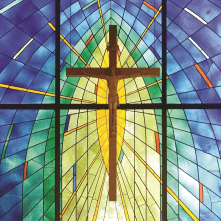
The new church had room for 700. The tabernacle and 6 stained glass windows were restored and placed in the new church. The Stations of the Cross and the crucifix over the altar were donated by Mercy Hospital. The statues of the Holy Family, carved from the same kind of wood as the carvings from the old church, were donated from the old Dowling Chapel. A statue of St. Joseph was visible in the garden behind the stained-glass window.
A building fund was started in 1978. Generous donations and pledges totaled nearly $135,000. On March 18, 1979, Bishop Dingman dedicated a new $1,000,000 church. With great joy, the parishioners gathered on April 25, 1981, to burn the mortgage.
In 1999-2000, the church was remodeled. The updates included removing the church carpeting. refurbishing the pews, enclosing the open walkway under the church, adding an elevator so parishioners could access the church from the back parking lot, adding a new classroom that was used as a library in the beginning and now is the music room.
While Fr. Hurley was at St. Joseph, he was instrumental in expanding the back parking lot. This included removing the street just north of the church, buying additional properties and setting the footings for the future gymnasium.
With the growth seen at St. Joseph, a daughter church was built in Altoona. "Out of the ashes a new church is born." In 1983, Saints John and Paul became an independent parish, beginning with 100 families. Today, we still pray for each other and interact through collaborative events.
Over the past 100 years, the St Joseph community has grown and changed in many ways. Our parish started with a small group of families, a farmhouse and a few barns. We have grown into a large church family with a beautiful worship space and newly renovated school. We are thankful for the work and determination of many dedicated volunteers and donations from our community and beyond for the growth in our parish and school. As we continue to be a beacon of faith on the east side of Des Moines, we know we have been truly blessed and will continue our strong commitment to God and our "Family Parish".
Our School
Catholic religious instruction was taught by the Sisters of Charity of the Blessed Virgin Mary, who came to the church every Saturday morning. The number of students averaged about 115. Beginning in 1944, about 60 students were bused to St Ambrose school while the parish began planning for their own school.
St. Joseph Parish began building the school and convent in 1948. The church had raised $30,000 to begin construction. St. Joseph School opened on September 19, 1949. Father Aspinwall then sent a petition to the Sisters of the Adoration of the Most Precious Blood in O'Fallon, Missouri and asked them to send some Sisters to work at our school. Three Sisters were sent in the fall of 1949, they were the first of their very distinguished Order to come to lowa. In 1949, 129 children attended St. Joseph School.
In 1962, an addition to the school building provided an auditorium, lunchroom and three more classrooms. In 1979, when the third church was built, two more classrooms and a resource/media center were added to the lower level of the church building.
The Sisters of the Most Precious Blood and lay-teachers instructed and educated the students for 23 years. In 1972, the Sisters of Humility began their teaching ministry.
From 2022 - 2024, the school had a major renovation. The long-awaited gymnasium was added to the north side of the school. This renovation included an elevator; new classrooms, including two preschool rooms; and a chapel dedicated to Fr. Dan Gehler. The addition will help sustain St. Joseph School for future growth. The gymnasium will be able to host basketball games and events creating opportunities for the school. The elevator will make the entire school available to everyone. The school has never had a chapel, so this is a great addition for the students.